That is exactly what Yamal means in the Nenets language. The end of the Earth!
It was one of the hardest trips I have ever taken, as I had to organise it from scratch, with no previous trip from Greece to this destination to go on. After six months of research, planning and countless phone calls, the organisation and the trip itself were a success.
The trip had it all…..Planes, trains, helicopters, all-terrain vehicles, sledges, snowmobiles, stays in a Russian log cabin with a banya (steam bath), in a chum with a Nenets family, in local homes and family-run hotels, a climb on the sacred mountain of Rai-Iz, visits to reindeer pastures, feeding reindeer, the Reindeer Festival, watching hockey matches and a school celebration. A trip…and an experience of a lifetime!
Before you travel to this magical place, I would like to introduce you to Yamal through my own eyes, after exploring it and experiencing it first-hand…..
The Yamal Peninsula
The Yamal Peninsula is washed by the Kara Sea, into which flows one of the largest rivers in the world, the Ob. Here it forms a vast bay, the Gulf of Ob. You can get here via Salekhard, the only town in the world that lies directly on the Arctic Circle.
Not far from Salekhard, along the River Ob, stretch the ranges of the ancient Urals, or to be more precise, their northern part – the Polar Urals. The Ural Mountains are around 600 million years old and contain many of Siberia’s precious minerals.
The Yamalo-Nenets Autonomous Okrug is comparable in size to Spain. Except that here, from November to May, it is winter. Temperatures at times drop to -60 degrees Celsius.
Yamal has some of the largest natural gas reserves in the world. But roads have always been a problem here: they are difficult and expensive to build on permafrost. In the 1950s the Soviet Union decided to build the Great Northern Railway. Construction was begun by Gulag prisoners. But after Stalin’s death the project was frozen. And so, even today, people still travel across the frozen rivers and lakes in all-terrain vehicles such as the UAZ and the TREKOL . The Ob winter road is the main transport artery connecting the whole of the peninsula with the rest of the continent. Another way of getting around is by helicopter. There are several flights every day to almost all the villages and small towns of the Yamalo-Nenets Autonomous Okrug.
Some areas of Yamal are protected, and you need a special permit to go there. The special permit is hard to obtain and takes at least 2 months, and every year the areas that require one change. So before visiting the region you should check with the local authorities.
The region also offers the spectacle of the Northern Lights (October–April), which makes it a magnet for tourists.
The indigenous peoples of the Yamalo-Nenets Autonomous Okrug
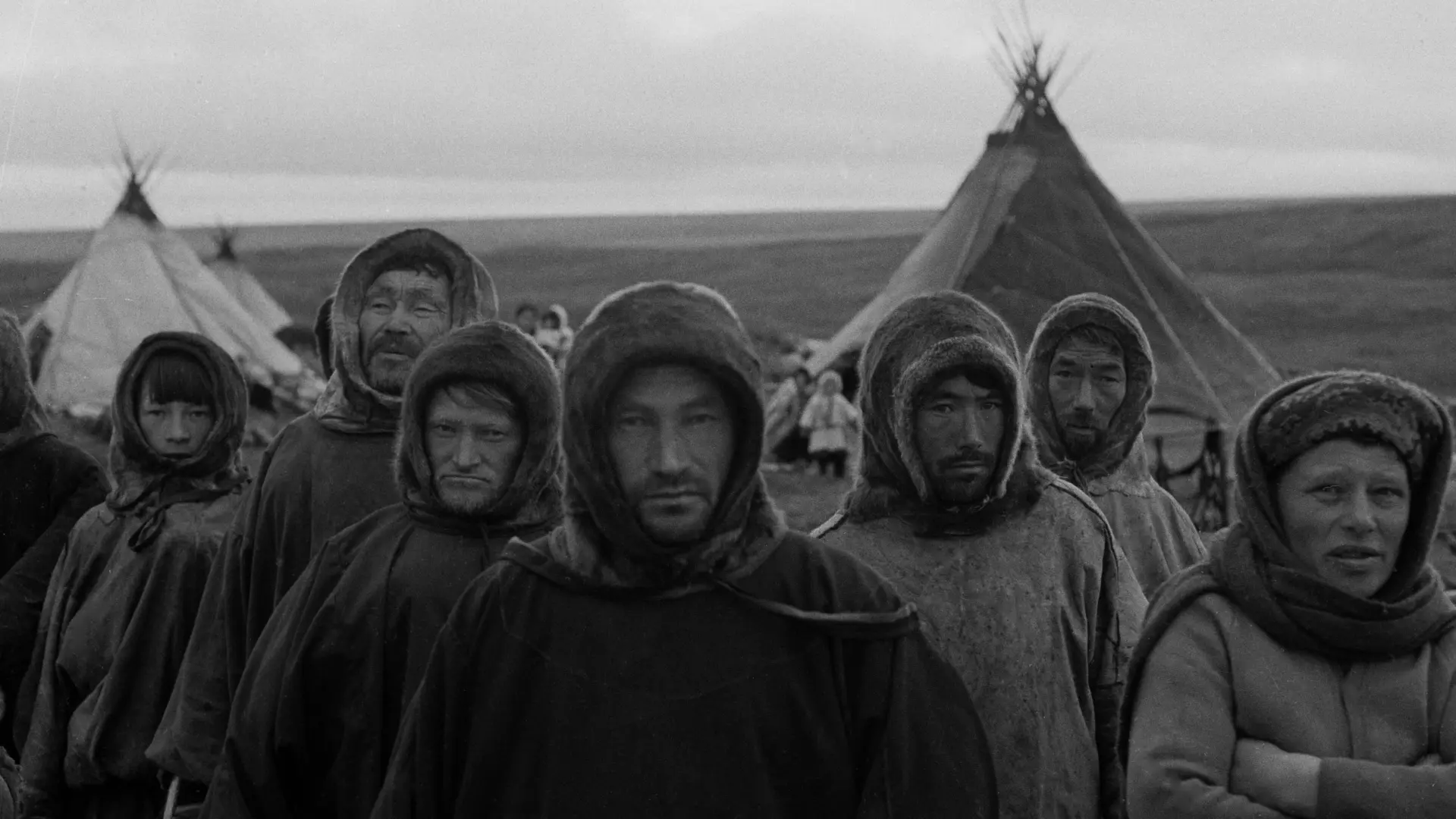
There are more than 40 different indigenous peoples across Siberia. The indigenous people of Yamal are the Nenets, but you can also meet other peoples, such as the Komi and the Khanty. They are fishermen, hunters and reindeer herders. Some of them live in chums and herd reindeer; others live in ordinary settlements on the banks of the River Ob.
A family of ten needs at least 600 reindeer to survive. Yet there are families with as many as 15,000 reindeer. For the Nenets, reindeer are not simply animals; they are their way of life, their behaviour, the very meaning of their existence. The Nenets describe themselves as “children of the reindeer”. Reindeer play a hugely important role in the life of the indigenous peoples, providing their food, their shelter, their transport and even their clothing. Many nomads also work with meat producers and pharmaceutical companies, selling them reindeer meat and antlers. Nomadic life is very hard, since to keep their reindeer fed the Nenets move across the tundra in search of new grazing grounds. A special breed of dog, the reindeer herding dog (Laika), helps the Nenets move their herds. In winter especially, they may move camp as often as every 3 weeks, as the pastures are exhausted very quickly. This is because in winter the reindeer feed exclusively on lichen. Lichens can live for many years, over 100, but grow very slowly, just 3–5mm a year.
Recently there has been marked climate change in the tundra, which has led to a shrinking of the pastures. This is a cause of great concern for the reindeer herders.
Officially, there are more reindeer in Yamal than people – around 600,000 head. However, local herders maintain that there are far fewer animals and that their number is falling every year.
Welcome to the chum!
The chum is the home of the Nenets and other indigenous nomads who live in the tundra. It is a tent made of Siberian larch poles, covered inside and out with reindeer hide. Its conical shape exists for a particular reason. The hole at the top symbolises the connection with the sun and the moon. Of course, the hole also has a practical purpose, as it lets out the chimney of the stove that heats the chum. The wealthier the family, the more spacious its tent (chum). The tent has a sacred part called the “si”, which is reserved for men only. The secret chest holds family heirlooms and, so the locals believe, sacred spirits. There is no furniture inside the chum. For babies there is a cradle lined with reindeer hide and moss, and lots of straps to hold the child in place.
The women look after lighting the fire, the cooking and the children. The food is simple and humble: reindeer, boiled fish, mushrooms and berries. The locals still eat raw meat; fresh reindeer blood, raw liver and kidneys are considered delicacies. This unusual diet saves the inhabitants of this inhospitable region from vitamin deficiency. Reindeer blood is even added to pancakes. The men spend a great deal of time tending the reindeer. They bring back wild animals from hunting: the meat is used for food, while the hides and fur decorate their clothes.
The Nenets are very hospitable and will look after you well if you stay in their chum. They will slaughter a reindeer in your honour and invite you to try the raw delicacies: warm reindeer blood, liver, raw meat and so on. They will give you the best corner of the home to sleep in and cover you with reindeer hide. In the morning they will wake you when breakfast is ready, which usually consists of sweetened tea and toasted bread rings, as well as buckwheat and reindeer soup.
The host of a chum will not tolerate seeing a guest’s cup empty: he will keep filling it with tea. The only way to stop this is to turn your empty cup upside down.
The Nenets are hospitable, but they also have certain rules you must observe when staying in their chum: do not interfere with the household chores; do not feed their dogs, which are specially trained and disciplined; go to bed at the same time as the rest of the family; and women must not pass behind the stove, or they will anger the evil spirit that brings illness, and so on. Never offer or give alcohol to the Nenets; you will only do them harm. Because of their DNA combined with their diet, the Nenets do not metabolise alcohol, get drunk easily and can end up in hospital.
Nenets children
The Nenets marry quite young and usually have many children. Until the age of 6, children stay with their parents in the tundra. At the age of 4, boys learn to throw a lasso and handle the reindeer, while little girls of the same age learn to sew and light a fire. The government of the Russian Federation provides special boarding schools for the children. So from the age of 6, children are separated from their parents to go to school. Because travelling from the tundra to the towns where the special schools are is extremely difficult, the Nenets see their children only once or twice a month. At school, besides basic knowledge and conventional lessons, young Nenets also learn about the ways, customs and traditions of their people. You can see this for yourself if you attend a school celebration, which usually coincides with the Reindeer Festival, which lasts almost a month and takes place in March.
After their basic education, most boys return to the tundra to learn the art of reindeer herding, hunting, fishing and so on. Girls, on the other hand, continue their studies, right up to higher education, and return to the tundra only if they marry.
The Russian government tries to discourage the Nenets from continuing their nomadic way of life and provides them with free housing in some of Yamal’s towns. As a result, some have abandoned life in the tundra and become town-dwellers.
The Reindeer Festival.
The reindeer celebration usually lasts from one to three days and is held on various dates in various parts of Yamal. The biggest celebrations usually take place in Salekhard, Aksarka, Novy Urengoy, Muravlenko, Tazovsky, Nadym, Yar-Sale and elsewhere. At the Reindeer Festival you can watch wrestling, lasso throwing, high and long jump, the national triple jump, reindeer sled races, relay races and archery, as well as best-costume competitions, master classes in handicrafts, woodcarving and bone carving, an exhibition of manufactured goods and food, and dances, songs and parades. The reindeer celebration matters a great deal to the Nenets, as after a whole year they get to see relatives and friends, and it is a chance to arrange marriages, buy and sell reindeer, trade goods and much more.
History
Like other northern Samoyedic peoples, the Nenets were formed from various tribal groups. During the first millennium AD, under pressure from the Huns, the Turks and other hostile nomads, the Samoyedic-speaking ancestors of the Nenets, who lived in the forest-steppe regions of Priirtysh and Pritobolny and in the taiga of the Middle Ob, moved north into the taiga and tundra of the polar and subpolar regions. There they merged with the native population of wild-reindeer hunters and sea-mammal hunters. The Nenets call themselves Neney Neneche, which means “real people”.
Religion
The Nenets believe in “spirits” – the guardians of the sky, the earth, fire, rivers and natural phenomena. The supreme sky deity, the demigod Num, ruled the world with the help of other deities and spirits, and his wife Ya-Nebya, “Mother Earth”, the old woman and protectress who gave birth to and sustained all living beings, guarded the home, the family and the hearth. Num’s adversary is Nga, the evil spirit of the underworld, a deity who brings sickness and death. Every lake or river had its own spirits – guardians. They sacrificed deer and made vows. Idols in human and animal form were placed at sacred sites, which could be stones, rocks or forests, at the foot or on the summit of mountain ranges.
Shamanism is closely bound up with the ancient religious beliefs of the Nenets. The title of shaman was passed down from generation to generation. A shaman could be either a man or a woman.
The Nenets worldview is a philosophy of oneness with nature. They do not attach any particularly tragic meaning to death, believing that the spirit of the deceased can find a new homeland. The dead are buried in family cemeteries, inside a chum.
In recent years most Nenets have converted to Christianity, and it is now hard to find a shaman.
Language
The Nenets speak the Nenets Samoyedic language, a member of the Uralic family, which is divided into two dialects: Tundra Nenets , spoken by most Nenets, and Forest Nenets. The forest dialect is spoken by around 2,000 Nenets, who are mainly settled in the taiga zone. They also speak Russian.
There are countless myths and truths about the life of the Nenets. I could write endless pages about what I experienced and the stories I heard, such as that the Nenets celebrate their birthday only once, or about the ultraviolet vision of reindeer, but it is better to see and hear these things for yourself, once it becomes possible to make this challenging journey again. In the meantime, you could watch the film “White Moss”, a love story set amid the harsh conditions of the tundra.
Cover photo: Viktor Zagumyonnov, Wikimedia Commons, CC BY-SA 4.0