

Central Asia
Uzbekistan
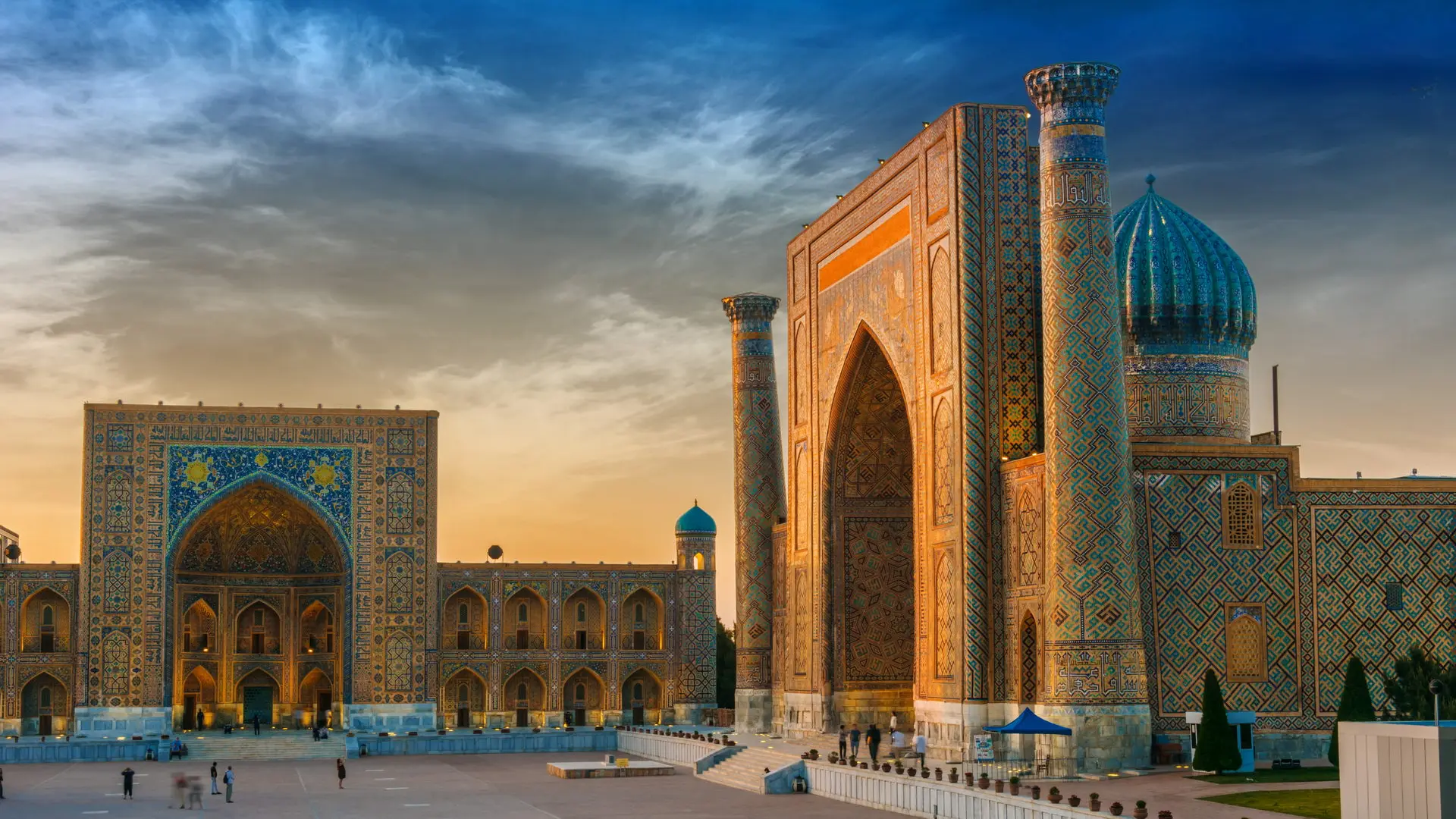
Uzbekistan is a diamond of ancient empires and a treasure trove of architectural monuments, the heart of the ancient cities of the legendary Silk Road.
Uzbekistan is a diamond of ancient empires and a treasure trove of architectural monuments, the heart of the ancient cities of the legendary Silk Road. World-famous cities such as Bukhara, Samarkand and Khiva were thriving here some 2,000 years ago. Beyond its archaeological and historic sites, Uzbekistan has a rich and varied natural world: the Kyzylkum Desert with its sand dunes, the foothills of the Tien Shan, the Pamir-Alai mountains thickly covered with juniper forests, and the valleys of the largest rivers in this part of Asia, the Syr Darya and the Amu Darya. The country offers a wide range of activities: hiking, eco-tourism, skiing, freeriding, rafting, fishing and safaris.
Here you can taste genuine Uzbek plov cooked to a recipe more than a thousand years old. The country will win your heart with the beauty of its historic monuments, its fantastic cuisine and the scent of its Eastern bazaars.
Uzbekistan lies in the central and northwestern part of Central Asia, between the Amu Darya and Syr Darya rivers. It stretches 1,425 kilometres from west to east and 930 kilometres from north to south, covering 447,400 square kilometres, with a population of more than 35 million. More than 130 nations and ethnic groups live here today: Uzbeks 72%, Russians 8%, Tajiks 5%, Kazakhs 4%, Tatars 2%, Karakalpaks 2%, as well as Kyrgyz, Turkmen, Koreans, Uyghurs, Jews, Armenians, Ukrainians and others.
Uzbekistan borders Kazakhstan to the north, Kyrgyzstan to the northeast, Tajikistan to the southeast, Turkmenistan to the southwest and Afghanistan to the south. It is a doubly landlocked country: it has no coastline, and neither do any of its neighbours.
About four-fifths of the country is plain, one of the main ones being the Turan Plain. In the north-central part lies one of the largest deserts in the world, the Kyzylkum.
The best seasons to travel to Uzbekistan are spring (April-May) and autumn (September-November), as summer is very hot, especially in July, and winter is cool and wet. The mountains are best visited from March to November, as the air there does not heat up as much as on the plains.
The climate is strongly continental: the land is arid, rainfall is low and humidity is low.
The coldest month is January, when temperatures in the north fall to -8 °C and below, while in the far south, around Termez, they can stay above zero. Absolute winter lows are 35-38 degrees below zero.
The hottest month is July, and July-August in the mountains. Average temperatures on the plains and foothills are 25-30 °C, while in the south (Termez and Sherabad) they reach 41-42 °C.
Journeys
Travel to Uzbekistan
New departures are being prepared. Contact us for tailor-made dates.
Tailor-made
Dreaming of Uzbekistan on your own dates?
We design private journeys for families, friends and groups.