In the state of Tamil Nadu in South India, there is a town where people live in peace and harmony, above all creeds, free from political, religious, racial and nationalist divisions, and open to people from all over the world.
The idea….
The creation of this “experimental” town was based on the idea of an ideal settlement, where everyone lives in harmony with themselves, their soul and the people around them, working constantly at self-improvement; where there are no social classes, and where each person finds their place in life, finds work to do and helps make the world around them a better place.
The town was named Auroville (City of Dawn), and it is an international project of UNESCO and the Indian Ministry of Education.
The history and layout of the town…..
Auroville appeared on the map of India in 1968. It was founded by a Frenchwoman, Mirra Alfassa (known as the Mother), a follower of Sri Aurobindo, the Indian philosopher and organiser of the national liberation movement. India’s former prime minister Indira Gandhi described Auroville as “an exciting project which brings with it the harmony of different cultures and an understanding of the environment that must exist for the spiritual growth of humankind”.
The original plan envisaged a population of around fifty thousand. By 2018 the number had reached roughly 3,000. Of these, 50% are Indian and the rest ─ from 58 countries (such as Germany, Denmark, Italy, Russia and France), while for the time being there is not a single Greek.
Auroville is divided into 5 zones: cultural, international, industrial, residential and green.
The cultural zone includes facilities for cultural, educational, artistic and sporting activities.
The international zone has the guesthouses for foreigners and volunteers, and the residential zone the homes of the town’s residents.
The industrial zone includes small- and medium-scale industries, training centres, arts and crafts, as well as the town’s administration.
The green zone provides a variety of wildlife habitats and organic farms, serves as a source of food, timber, medicines and so on, and doubles as a recreation area. A great many projects are also carried out in the green zone to protect the environment, along with restoration work, waste management and the development of alternative forms of energy.
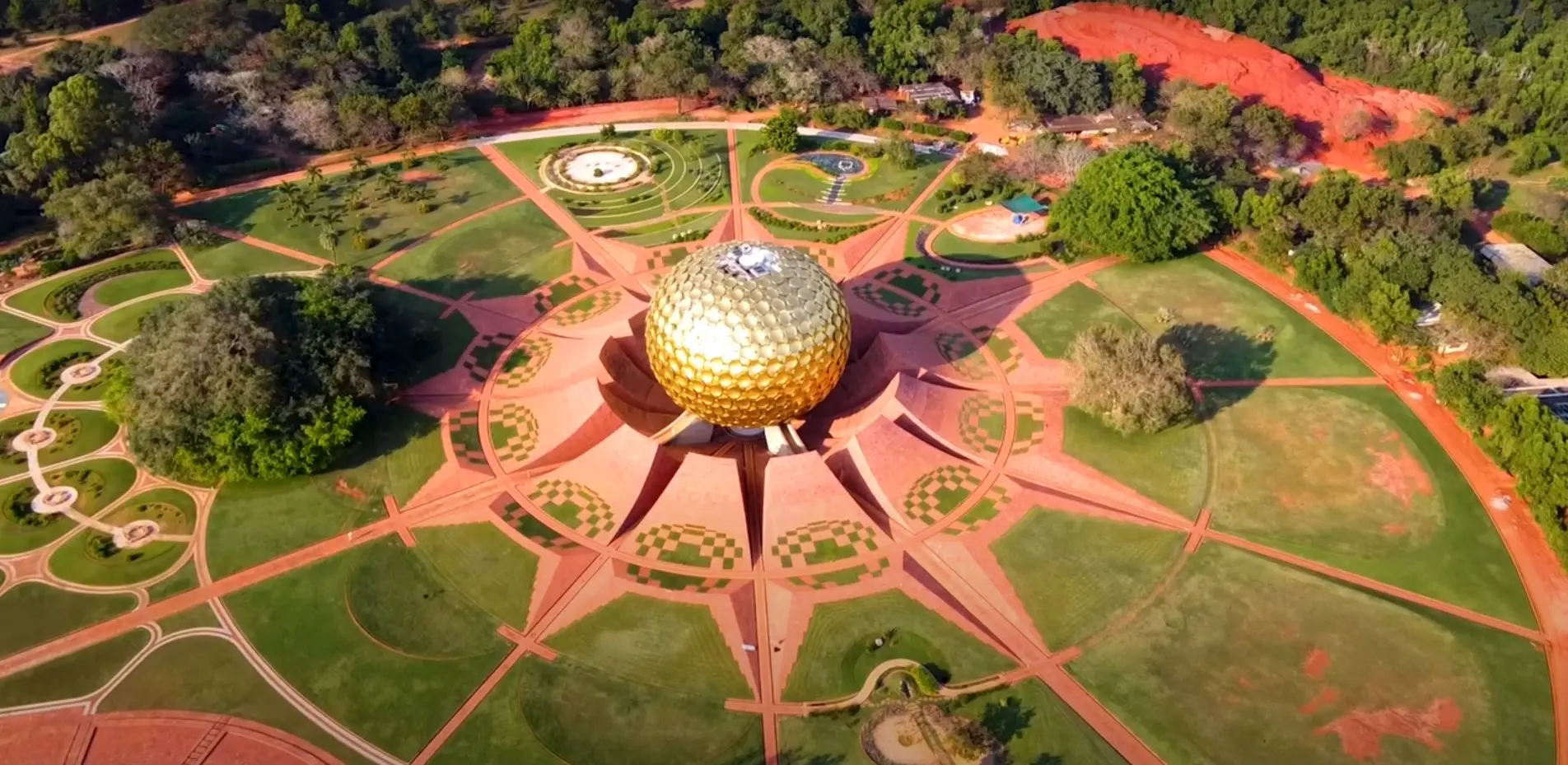
Since its founding, around 2 million trees have been planted in the town. As a result, it looks more like a forest, with many country lanes and very few signposts. None of the buildings in Auroville is taller than two or three storeys, so they are easily lost among so many trees. The town itself covers about 20 square kilometres. At its heart stand the Matrimandir and an enormous banyan tree (Indian fig).
The Matrimandir is a large golden dome set in a wide open area called “Peace”. Beneath the dome lies a large meditation hall. The Matrimandir (Temple of the Mother) was described by the Mother as “the symbol of the Divine’s answer to man’s aspiration for perfection”. The building is a sphere covered in discs clad with golden plates. The sphere rests on four pillars surrounded by twelve petals.
The banyan is the Indian fig, known for being a “walking tree”. Its huge branches reach down to the ground, take root and turn into trunks, so that the tree keeps spreading.
Life in Auroville …..
There are no political parties in Auroville, as membership of them is forbidden. Residents have no personal property – the land and assets belong to the Auroville Foundation, which is appointed by the Government of India. There is no hierarchy here either. To run things, the locals elect bodies such as the Working Committee and the Auroville Council, which handle administrative matters in the town but hold no power. Important issues are discussed at the Residents’ Assembly, where anyone can voice their opinion on a given subject.
An important rule of life in Auroville is that its residents must work five hours every day, Sundays included. The average age of Auroville’s residents is 30. There are few elderly people in the town, but even the oldest residents work.
Education, healthcare and attendance at cultural events in Auroville are free.
The language of instruction at school is English. Learning languages is a priority. Full, structured schooling begins at the age of 14; before that there is a preparatory period in which particular emphasis is placed on physical education and on developing individual abilities. At secondary level, all subjects are optional. There are no marks or exams at school. There are no tests either. Auroville’s graduates go on to higher education in Europe. They have no secondary-school leaving certificate and can only apply to those European universities that admit students on the strength of a piece of academic work submitted as proof of their education.
There are no homeless people and no beggars. But there are no rich people either.
All bad habits are banned: drugs, alcohol, smoking.
Marriages are not officially registered. If a couple decides to live together, that is enough for them to start a family. Likewise, they separate of their own free will. But children are supported by the town, and there are special programmes designed to make sure every child has all their needs met.
There is no hospital in the town. There is, however, a Health Centre.
The main means of transport in the town are bicycles, scooters and kick scooters.
The Charter of Auroville…….
Auroville belongs to nobody in particular. Auroville belongs to humanity as a whole. But to live in Auroville, one must be a willing servitor of the Divine Consciousness.
Auroville will be the place of an unending education, of constant progress, and a youth that never ages.
Auroville is a bridge between the past and the future. Its purpose is to boldly bridge the gap between the past and the future, taking advantage of all discoveries from within and without Auroville.
Auroville is a site of material and spiritual research, preparing a living embodiment of an actual human Unity. Auroville welcomes all people of goodwill. Auroville welcomes everyone with the appetite to evolve and a thirst for a true life of real quality.
If anyone wants to join this utopian paradise, all they have to do is apply; they will then be interviewed and go through a one-year trial period, working and living according to the town’s rules. After a year they will go before the Auroville Council and become a permanent resident. Some claim that the whole town is essentially a cult, but I don’t agree. I saw very calm, happy people there. I feel truly blessed to have been there….The whole town genuinely radiates a positive aura, and you feel calm and at peace as you walk through its endless forests and gardens.
Elli K.