Armenia · Georgia
Exploring the Unknown Trails of the Caucasus
INDIVIDUAL – GROUP TRIP
- Duration15 days
- Departs fromAthens or Thessaloniki
- Next departureAsk us
Overview
The journey
- You will experience the authenticity of some of the most hospitable countries in the world
- You will meet the inhabitants of the highest permanently inhabited alpine community, Ushguli
- You will hike to the Chalaadi glacier in the most mountainous part of the Svaneti region
- You will cross the mythical Prometheus Cave by boat
- You will dine at the finest traditional restaurants of the Caucasus with live music and dancing
- You will learn to cook traditional Caucasian dishes and sweets
- You will be enchanted by a geological phenomenon unique in the world, the 'Symphony of Stones'
- You will experience Caucasian hospitality in an authentic Caucasian home
- You will explore unique ancient cities carved into the rock
INDIVIDUAL – GROUP TRIP
Notes
- The trip can be made with a passport that does not expire within six months of your departure from the destination
- The agency reserves the right to change the programme depending on the circumstances that arise.
Day by day
Itinerary
Day01Thessaloniki – Kutaisi – Mestia (212 km)
Meet at Macedonia Airport and fly to Kutaisi. Arrival at Kutaisi airport at 12:10.
Kutaisi is one of the oldest cities in Transcaucasia, founded in the 2nd millennium BC, and was the capital of the ancient Kingdom of Colchis. According to Apollonius of Rhodes, it was the final destination of the voyage of the Argonauts. Today the locals seem to keep this legend alive with pride, as replicas of the legendary Argo appear on many emblems and at many spots around the city.
After a first taste of the city we leave for the Svaneti region. 212 km.
On the way you can stop for a meal at a traditional open-air tavern (optional).
Arrival in the regional capital, Mestia.
Check-in at the hotel. Overnight.
Day02Mestia – Ushguli (46 km)
Early in the morning, after breakfast, we leave for Ushguli.
The only way to get there is by off-road 4x4 vehicles.
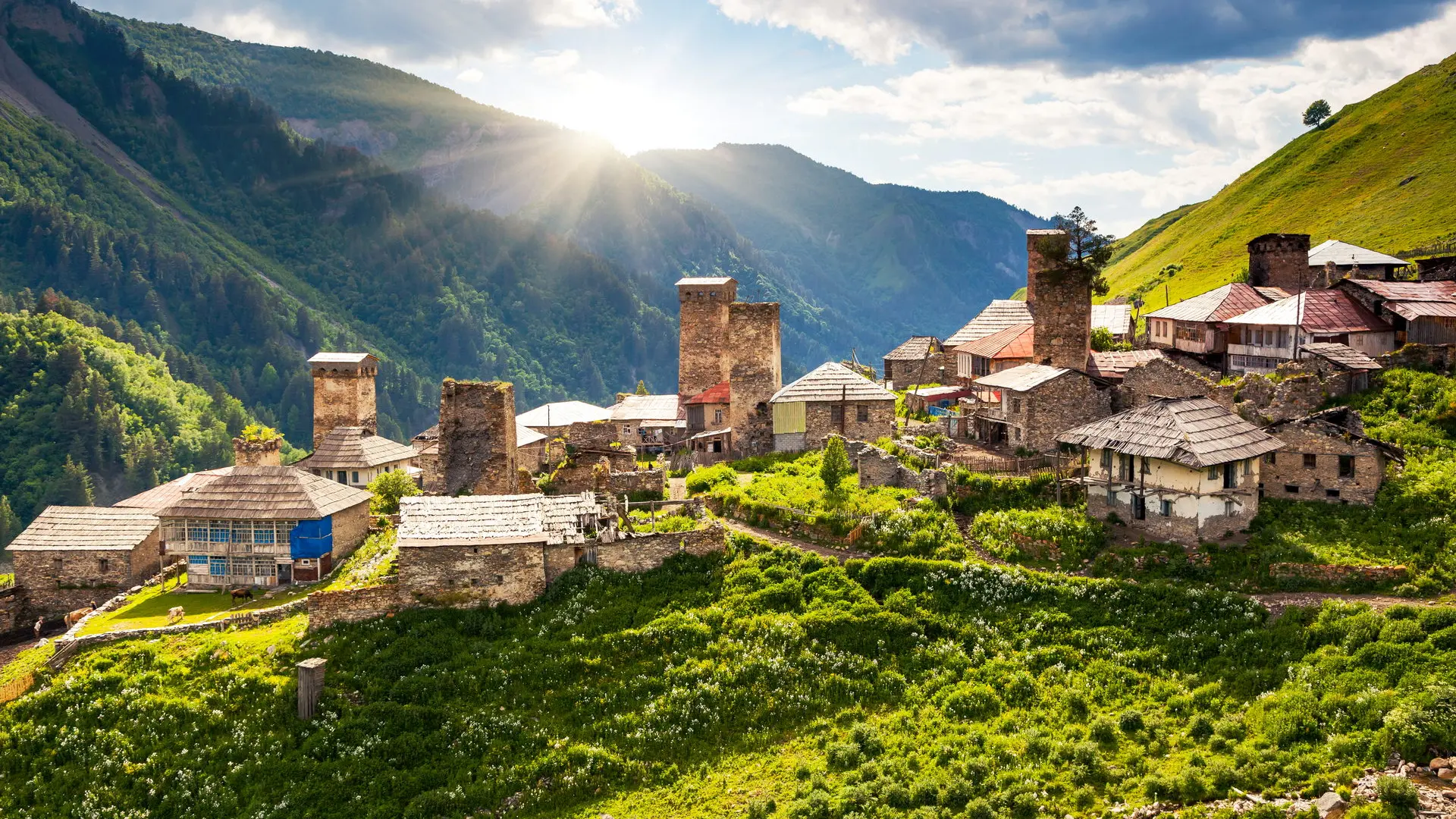
Ushguli is the highest permanently inhabited alpine community (not village!) in Europe. It lies at an altitude of 2,200 metres in eastern Svaneti, at the head of the Inguri river, at the foot of Mount Shkhara (5,068 metres). It is 33 kilometres from Mestia. The Ushguli community is made up of four villages – Zhibiani, Chvibiani, Chazhashi and Murkmeli.
In the villages you will see many castles and towers (there were originally 200). Some towers are churches, some museums and some traditional houses and guesthouses of unique architecture. You will see the Church of St George, as well as the Churches of the Saviour and of St Barbara. You will also see the Upper and Lower Chazhashi castles with their many towers. It is said that the palace in the upper castle was once the residence of Queen Tamar.
(Ask to see the house museum and to have lunch at a traditional tavern) optional.
Thanks to its well-preserved medieval architecture, Ushguli is a UNESCO World Heritage Site. Ushguli's oldest buildings date from the 9th to the 10th century; however, according to archaeological evidence, the settlement existed long before that.
Return to Mestia. Overnight.
Day03Mestia – City tour – History Museum – Glacier
Chalaadi (12.6 km)
After breakfast we tour Mestia.
Mestia is the capital of the Svaneti region, regarded as the most mountainous region of Georgia. It has 2,600 permanent residents and lies at an altitude of 1,500 m above sea level. Of all the mountain peoples of Georgia, only the inhabitants of Svaneti built churches and painted icons. It was a closed society without any influence from the outside world. That is why they developed, and still keep to this day, a distinctive way of life and culture unlike anyone else's.
Nevertheless, the centre of the capital was redeveloped by the German architect Jürgen Mayer, and today the centre of Mestia is no different from a modern square in a European city, with the glass building that houses the town hall, the police and the courthouse.
You will then visit the History Museum.
Straight afterwards we head to the most mountainous part of the Svaneti region, on the border with Russia, to hike to the Chalaadi glacier. The Chalaadi glacier lies on the southern slope of the Caucasus, at the source of the Mestia-Chala river. The glacier is at an altitude of 1,850 metres. It is the only glacier in a forest zone and is fed by snow from the peaks of Bzheduhi, Chatini and Dalaqori.
The bus will drop you at the bridge, and from there a 45-minute hike follows.
Return to Mestia. You can dine at one of the traditional restaurants if you wish (Café Laila).
Overnight.
Day04Mestia – Prometheus Cave – Tbilisi (450 km)
After breakfast we set off on our long journey to Tbilisi, the capital of Georgia.
On the way we visit the mythical 'Prometheus Cave', one of the richest caves in Europe.
The route through the cave is 1,060 metres long and we will see a great many underground rivers and beautiful scenery. The return from the cave could be made along the underground river by boat, so that we can admire the cave's stalagmites and stalactites up close.
I suggest dining on the way at a traditional Georgian restaurant (optional). Arrival in Tbilisi, overnight.
Day05Tbilisi – City tour – National Museum – Byzantine Museum
After breakfast we tour the old and the modern city of Tbilisi, a blend of many different cultures. Here European and Eastern elements combine to produce Georgian culture. The harmonious union of old and modern leaves not even the most demanding visitor unmoved. Only here in Tbilisi, in one neighbourhood of the old town, can you see an Orthodox church, a synagogue, a mosque and an Armenian church side by side. Everyone in the street tries to help you and be of service. We will visit Metekhi Church (13th c.), Narikala Fortress (4th c.), the Sulphur Baths – a favourite spot of Tbilisi's residents and of foreigners alike – Sioni Cathedral (6th-7th c.), which holds the cross of St Nino and a nail from the Cross of Christ, the Anchiskhati Basilica (6th c.), one of the oldest monuments of the basilica type, and the Georgian Museum of Arts, as well as Rustaveli Avenue with its luxury shops and imposing buildings, the Opera, the Parliament and more.
We will visit the National Museum and the Byzantine Museum.
In the evening we dine at a traditional restaurant overlooking the river, with live music and traditional dancing.
Return to the hotel. Overnight in Tbilisi.
Day066
Day 6: Tbilisi – Mtskheta – Gori – Uplistsikhe (84 km)
After breakfast we set off for the town of Mtskheta (the old capital of Iberia). We will have a guided tour of Svetitskhoveli Cathedral (the symbol of Georgia's conversion to Christianity, rebuilt between 1010 and 1029) and Jvari Monastery (the Cross) (6th-7th c.). Both are UNESCO World Heritage Sites.
We continue to Gori, birthplace of Ioseb Besarionis dze Jughashvili, known worldwide by the pseudonym Stalin. In the museum named after him we will see his personal belongings and learn about little-known aspects of the early years of the controversial leader.
Next, the cave city of Uplistsikhe (Fortress of God) awaits us, dating from the 4th-6th century BC, an ancient settlement carved into the rock.
(You can dine at a picturesque restaurant on the way to Tbilisi to try traditional Georgian dishes (khinkali and khachapuri)) optional.
Overnight in Tbilisi.
Day07Tbilisi – Ananuri Fortress – Stepantsminda – Holy Trinity Church (154 km)
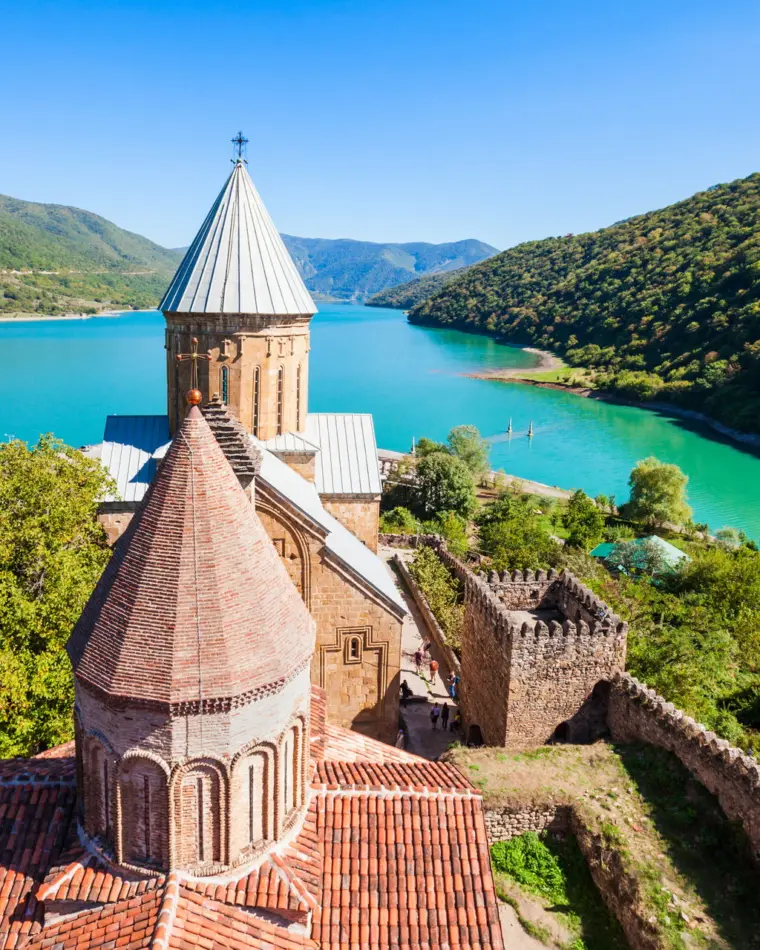
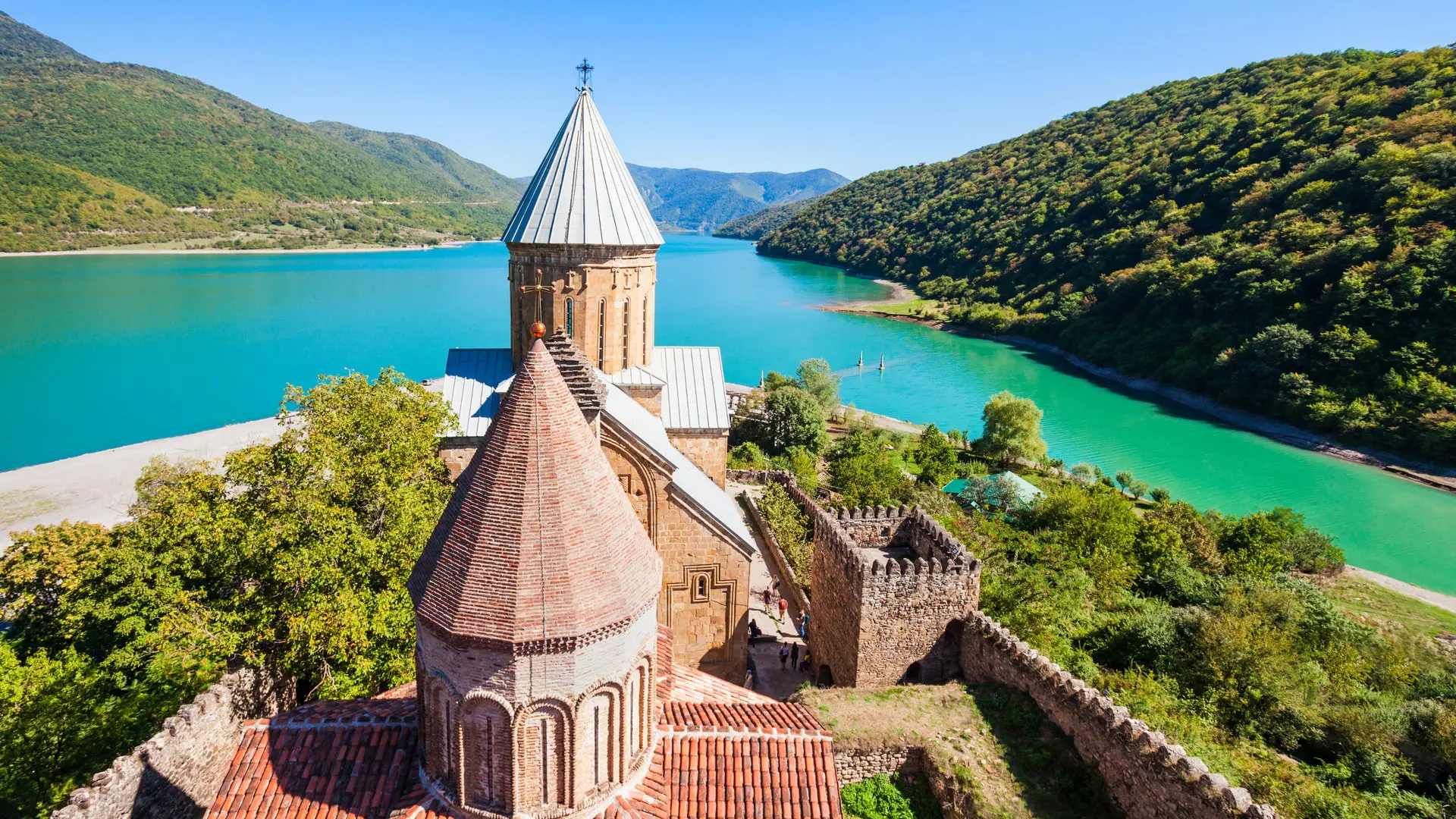
After breakfast we leave for the Stepantsminda area at the foot of Mount Kazbek, taking the Military Road – the main road linking Georgia with Russia (named 'military' by the Russian Tsar Alexander I) – to reach the small town of Kazbegi, one of the most beautiful and highest places in the Caucasus. On the way we visit Ananuri (16th-17th c.), a fortress and monastery with architectural features typical of the late Middle Ages.
We will also admire the Russia–Georgia Friendship Monument at Gudauri, one of the largest ski resorts in Europe.
We then climb by 4x4 up the Holy Trinity mountain to an altitude of 2,179 metres above sea level, where we visit Gergeti, the Holy Trinity Church (14th c.), which stands on the mountaintop surrounded by beautiful glaciers.
I suggest dining at a restaurant in Stepantsminda (optional).
Return to Tbilisi. Overnight.
Day08Tbilisi – Haghartsin – Goshavank – Dilijan – Yerevan (276 km)
After breakfast we leave for the Georgia–Armenia border (Sadakhlo/Bagratashen). After the formalities we continue our journey, now on Armenian soil.
Our first stop is the 13th-century Haghartsin Monastery, nestled among lush forested mountains, one of the most popular monasteries in Armenia and home to some of the most impressive khachkars ('cross-stones') in the world. These rectangular stone steles, on which crosses with richly decorative elements are engraved or carved, are one of the most characteristic expressions of Armenian art. Haghartsin lies in beautiful Dilijan, 'Little Switzerland' as the locals call it, one of Armenia's most important resorts. (A stop here for coffee and a snack is a must. If you have time, see Dilijan National Park too – optional.)
We then see Goshavank Monastery, one of the country's most famous religious and cultural centres.
We reach Yerevan late in the evening. Overnight.
Day09Yerevan – City tour – Matenadaran – History Museum – Genocide Memorial and Museum
Cascade (centre of art)
After a hearty breakfast we begin our tour of the Armenian capital, Yerevan. Armenians call the city Yerevan, meaning 'the visible one', because, according to legend, it was the first place Noah saw after the Flood. It is a city of remarkable historical importance, bound up with the trials of the Armenian people. A city with a modern atmosphere and an ancient history, with dozens of theatres, concert halls, galleries and live-music clubs.
We will see Republic Square and the Opera, which bears the name of the great composer Alexander Spendiarian.
Next comes a visit to the Armenian Genocide Memorial and Museum on Tsitsernakaberd hill, whose name means 'Swallow's Fortress'. The Armenian Genocide took place in 1915, and more than 1 million Armenians were killed. The memorial symbolises the rebirth of the Armenian people, and in the museum we will see real photographs and videos that bear witness to the painful events.
There is the option of visiting the Matenadaran, the state institute of manuscripts, which holds 12,000 Armenian and 3,000 foreign-language manuscripts of inestimable historical value. Overnight.
It is worth visiting the History Museum and, of course, the Cascade, a huge open-air and indoor gallery exhibiting very distinctive works by artists from all over the world. It is built on many levels and resembles a giant waterfall.
Finally, we visit the 'Ararat' brandy factory – Armenian brandy is known internationally and was Winston Churchill's favourite drink.
Return to the hotel.
Day1010th
Day 10: Yerevan – Garni – Geghard – master class – Lunch in a local home (30 km)
After breakfast we set off for the Temple of Garni, a true jewel of Hellenistic architecture and the only example from the pagan period in Armenia. King Trdat I commissioned the temple in the 1st century AD and dedicated it to the sun god. After the adoption of Christianity in 301 AD, the pagan temple lost its significance and Garni fortress was used as a summer residence of the kings. Today the ruins of the palace and the baths with their dazzling mosaic lie near the temple.
In Kotayk province, not far from the village of Garni, lies one of Armenia's best-known and most beautiful natural monuments – the 'Symphony of Stones'. The monument consists of huge symmetrical hexagonal and pentagonal basalt columns (almost 50 metres high). It is said that this natural monument is the result of the settling of volcanic rock. These stones, hanging in defiance of gravity, resemble an organ. The Azat river flows through the gorge, enriching the hypnotic beauty of the stones with its murmur. From the monument's grounds you can also enter the Khosrov Forest reserve and discover one of Armenia's specially protected areas.
We continue to Geghard Monastery, a 13th-century masterpiece of Armenian architecture carved into the rock. Its name means 'spear', because for many centuries it held the spear with which the Roman soldier pierced the side of Jesus Christ. The building is constructed in such a way that it is an ideal place for listening to religious music.
Visit to a local country house, where the hostess will bake the traditional Armenian flatbread, Armenian 'lavash'. We will then have lunch, enjoying traditional Armenian dishes.
Return to Yerevan. Overnight.
Day11Yerevan – Khor Virap – Etchmiadzin (45 km)
Breakfast and departure on an excursion to the Khor Virap monastery complex. It is the most famous monument of religious interest in Armenia, as it is directly linked to the region's conversion to Christianity. Christianity was adopted as the official religion of Armenia in 301 AD thanks to the efforts of St Gregory the Illuminator, who had previously been imprisoned in the dungeon on whose site the church of Khor Virap monastery was later built in the 17th century. The monastery offers us a breathtaking view of biblical Mount Ararat.
Traditional lunch in an Armenian home, where the hostess will show us how to make traditional Armenian sweets such as 'gata', as well as pasta.
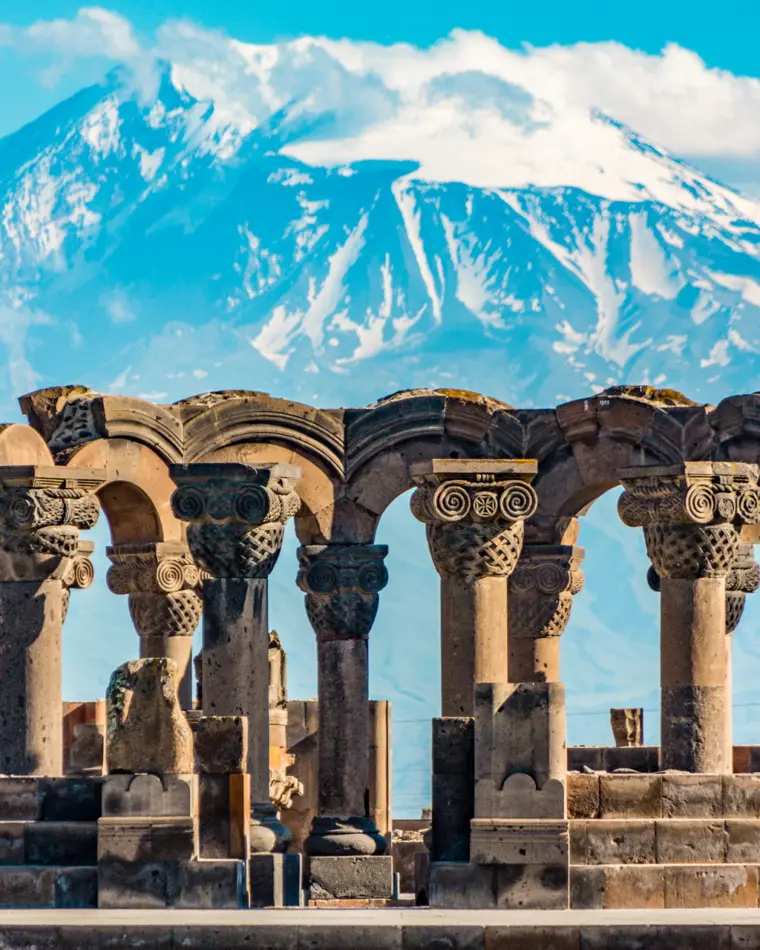
We continue to Etchmiadzin, the country's religious centre and seat of the Armenian Patriarchate, the 'Vatican' of Armenia. The name Etchmiadzin means 'The Descent of the Only Begotten Son' in Armenian. This small ancient town, about 20 kilometres from Yerevan, gained particular importance when Armenia declared Christianity the official state religion, following a vision of St Gregory the Illuminator, who saw Jesus Christ descend from heaven and point to the spot where in 301 the Holy See (Mother Cathedral) was founded, on the site of the pagan temple of the city of Vagharshapat, after it had been destroyed by King Trdat. This cathedral is one of the oldest churches in the world. In the same area we will also visit the ruins of the 7th-century Zvartnots Cathedral, of exceptional architectural value, the Church of St.Hripsime, one of the oldest surviving churches in Armenia, and the Church of St.Gayane, of the 7th century, which in 2000 was included among UNESCO's World Heritage Sites.
Return to Yerevan. Overnight.
Day12Yerevan – Lake Sevan – Kakheti – Telavi – Gremi – Nekresi (360 km)
After breakfast we begin our return to Georgia.
Before leaving Armenia we take a beautiful drive to Lake Sevan, the largest in Armenia (area 940 km2, length 80 km and maximum width 30 km). Sevan lies at an altitude of 1,900 m above sea level and is a famous holiday destination. After admiring the view of the lake from Sevanavank Monastery, which means 'Sevan monastery' in Armenian, we continue to the border.
After crossing the border and changing vehicle and guide, we continue to Kakheti, a region of Georgia known for its many churches and its famous wines. There we visit Nekresi Monastery, one of the oldest Christian churches in Georgia. Nekresi Monastery was an important spiritual, educational, cultural and political centre. We then visit the Gremi Archangels' Church complex (a 16th-century complex with Georgian and Persian elements), which was nominated in 2007 and has been included on the list of monuments under UNESCO protection.
Arrival at the very special hotel-castle-winery.
Dinner (optional).
Overnight.
Day13Telavi – Bodbe Monastery – Sighnaghi
master class – winery
Breakfast and we set off for Bodbe, the monastery of St Nino (4th c.), one of the important Christian centres of Georgia, home to the tomb of St Nino, who brought Christianity to Georgia in the 4th century. We will have a guided tour of the town of Sighnaghi, the mountain town built in the 18th century and surrounded by a wall second in size in the world only to the Great Wall of China. We will enjoy the view over the Alazani river valley.
We then visit the Pirosmani Museum. Niko Pirosmanashvili (1862-1918) was a self-taught Georgian folk painter. He is considered the Theophilos of Georgia, because his life resembles that of the Greek painter Theophilos Hatzimichail. Pirosmani was a primitive painter: distinctive, obscure, modest and scorned. He died poor, leaving many paintings on the walls of the taverns of Tbilisi.
Transfer to our hotel in Telavi, where we will learn the Georgian art of making wine in traditional 'qvevri'. These are large clay vessels buried in the ground and used for fermenting and storing wine from antiquity to the present day.
We will then take part in cooking the traditional dishes khinkali and khachapuri, in baking traditional Georgian bread, and in a tasting of Georgian wines. The hotel chef will cook his speciality exclusively for us, followed by a traditional Georgian dinner with a tamada.
Overnight.
Day14Telavi – Kutaisi – City tour – Gelati Monastery
After breakfast we head back to Kutaisi. On the way we pass through the Surami area, known for its castle and monastery. Break for coffee and a snack (optional).
Arrival in Kutaisi, where we begin with a tour of the city, whose central square is adorned by the Colchis fountain with its 30 statues.
The city is home to two UNESCO World Heritage Sites, Bagrati Cathedral
and the Gelati Academy/Monastery.
We then visit the Gelati Academy and Monastery, founded by King David in 1106; you can see his tomb at the southern end of the cathedral, at the main entrance. The popular and revered King David wanted to be buried in a place where everyone coming to the monastery would first pass over his tomb, and according to legend the tomb is the same length as the king's height. During the 12th-13th centuries Gelati was one of the greatest religious, educational, scientific and philosophical centres of Georgia.
Check-in at the hotel and overnight in Kutaisi.
Day15Kutaisi – Thessaloniki
We wake up very early in the morning to go to Kutaisi airport for our return flight. Arrival in Thessaloniki early in the morning.
Good to know
What's included
Included
- 4 nights in a 4* hotel in Tbilisi
- 2 nights in a 4* hotel in Telavi
- 3 nights in a 4* hotel in Mestia
- 1 night in a 4* hotel in Kutaisi
- 4 nights in a 4+* hotel in Yerevan
- Daily breakfast, 2 meals in traditional homes in Armenia and 2 traditional dinners in Georgia.
- Transfers and all internal transport provided for in the programme.
- Comprehensive guided tours, sightseeing and excursions as described in the programme.
- Liability insurance
- Greek-speaking local guides.
Not included
- Air tickets
- Entrance fees to museums and archaeological sites.
- Extra expenses at the hotel.
- Alcoholic drinks.
- Extra meals and anything mentioned as optional.
Moments
Gallery
Keep exploring