

India
In the Footsteps of the Tribes of Unknown India
- Duration15 days
- Departs fromAthens or Thessaloniki
- Next departure30 Nov 2026
Overview
The journey
- Attend the spectacular Hornbill Festival, the greatest celebration of the tribes of Nagaland.
- Explore little-known Northeast India, a region very few travellers get to see.
- Meet five different tribes of India and visit authentic tribal villages.
- Meet the Konyak Naga, descendants of the legendary headhunters, in the remote villages of Nagaland.
- Visit unique Longwa, the village that lies in two countries at once, India and Myanmar.
- Discover the rare culture of the Apatani, one of the most distinctive tribes in Asia.
- Explore Majuli, the largest river island in the world and the spiritual centre of Assam.
- Access Protected Areas with special entry permits, rarely visited by travellers.
- Hi-tea with a local family in Nagaland, an authentic experience of hospitality.
Flights & departures
Turkish Airlines flights | Athens – Delhi – Athens
29 November – 13 December 2026
29 NOV | TK1850 Athens – Istanbul | 15:45 – 18:25
29 NOV | TK716 Istanbul – Delhi | 20:50 – 05:20 (+1)
13 DEC | TK717 Delhi – Istanbul | 07:00 – 11:35
13 DEC | TK1849 Istanbul – Athens | 14:25 – 14:55
Notes
Important travel information
- Roads in Northeast India are not always in good condition, especially in remote parts of Assam, Arunachal Pradesh and Nagaland.
- The weather is unpredictable, so we recommend bringing waterproofs or rain gear.
- The programme may change because of unforeseen events such as:
- road closures
- strikes
- weather conditions.
- On mountain routes vehicles run without air conditioning.
- Mobile and internet coverage is limited in Arunachal Pradesh and Nagaland.
- Power cuts are common in winter.
- A small donation to the community may be requested for photography or filming in villages.
- Because accommodation in the region is very limited and demand during the Hornbill Festival is very high, bookings must be completed by 15 May to secure accommodation and local guides.
- Museums and sights may be closed on local or national holidays.
- A local guide in the villages of Arunachal Pradesh and Nagaland is compulsory.
- Local guides are often used to translate local dialects and may not speak fluent English.
- Visits to tea factories depend on their operation and permission.
- From November to early April tea picking is limited because of winter, so production may not be fully visible.
- In places such as Mon and Ziro hotel options are limited.
Even the best lodgings are standard category and cannot be compared with big-city hotels. - Domestic flights within India allow checked baggage up to 15 kg and hand luggage up to 7 kg.
Day by day
Itinerary
Day01Athens – Delhi
Meet at Athens Eleftherios Venizelos airport and fly to Delhi via a connecting airport.
Day02Delhi – city tour – optional visit to the Taj Mahal
Arrival in Delhi, where our local representative meets us and takes us to the hotel.
In the afternoon, a gentle introductory tour of New Delhi, ideal for a first contact with India without strain after the long flight.
We visit the Qutub Minar, the tallest brick minaret in the world and a UNESCO World Heritage Site, a symbol of the beginning of Islamic architecture in India.
Then we visit Humayun's Tomb, a Mughal masterpiece and forerunner of the Taj Mahal, set in symmetrical gardens that radiate calm and grandeur.A panoramic drive follows past New Delhi's government buildings, such as India Gate, the Presidential Palace and the ministries, showing the modern, official side of the capital.
Return to the hotel.
Overnight in Delhi.
*For those who wish, a day trip to Agra to see the Taj Mahal can be arranged.
Day03Delhi – Guwahati – Tezpur
Flight to Guwahati. On arrival we meet our local guide at the airport and drive straight to Tezpur, one of the most atmospheric towns in Assam.
The drive unfolds past green tea gardens, endless rice paddies and idyllic landscapes against the snow-capped Himalayas, which frame the horizon and give the scenery an almost cinematic feel. Nature here is not just beautiful; it is generous, alive and captivating.
Tezpur has deep historical roots. According to historical records it was known as Haruppesvara under the Mlechchha dynasty (650–900 AD), and the rock inscriptions of Harjara Varman show the town already existed in 829–830 AD, making it one of the oldest continuously inhabited settlements in the region.
Modern Tezpur took shape in 1835, when it was officially founded by the British colonial administration. Thanks to its strategic position it became an important trading centre and river port, vital for trade throughout Assam.
After Indian independence Tezpur kept its key role and was where the first power station in this part of the country was built, a symbol of the transition from traditional to modern.
Time permitting, we visit the ruins of the Da Parbatia temple (6th century), one of the most important archaeological monuments in Assam, with a finely carved doorway that shows the high artistic standards of the era.
We then visit Cole Park, a green space with medieval stone sculptures and architectural fragments rescued from across the region, an open-air museum where history, art and nature coexist.
Overnight in Tezpur.
Day04Tezpur – Ziro
(240 km / about 5 hours)
Early departure on one of the most beautiful drives in Arunachal Pradesh to Ziro, rightly called the "secluded paradise" of the state. At about 1,500 metres, Ziro keeps a rare sense of isolation, peace and authenticity, far from mass tourism.
As the landscape changes, green hills covered in bamboo and pine appear, surrounded by rice fields that embrace the land in perfect geometric lines, a balanced, almost poetic scene that invites you to slow down.
Ziro is home to the very hospitable Apatani, one of the most distinctive tribes of Northeast India, known for their deep respect for the land, their community and their traditions.
The Apatani
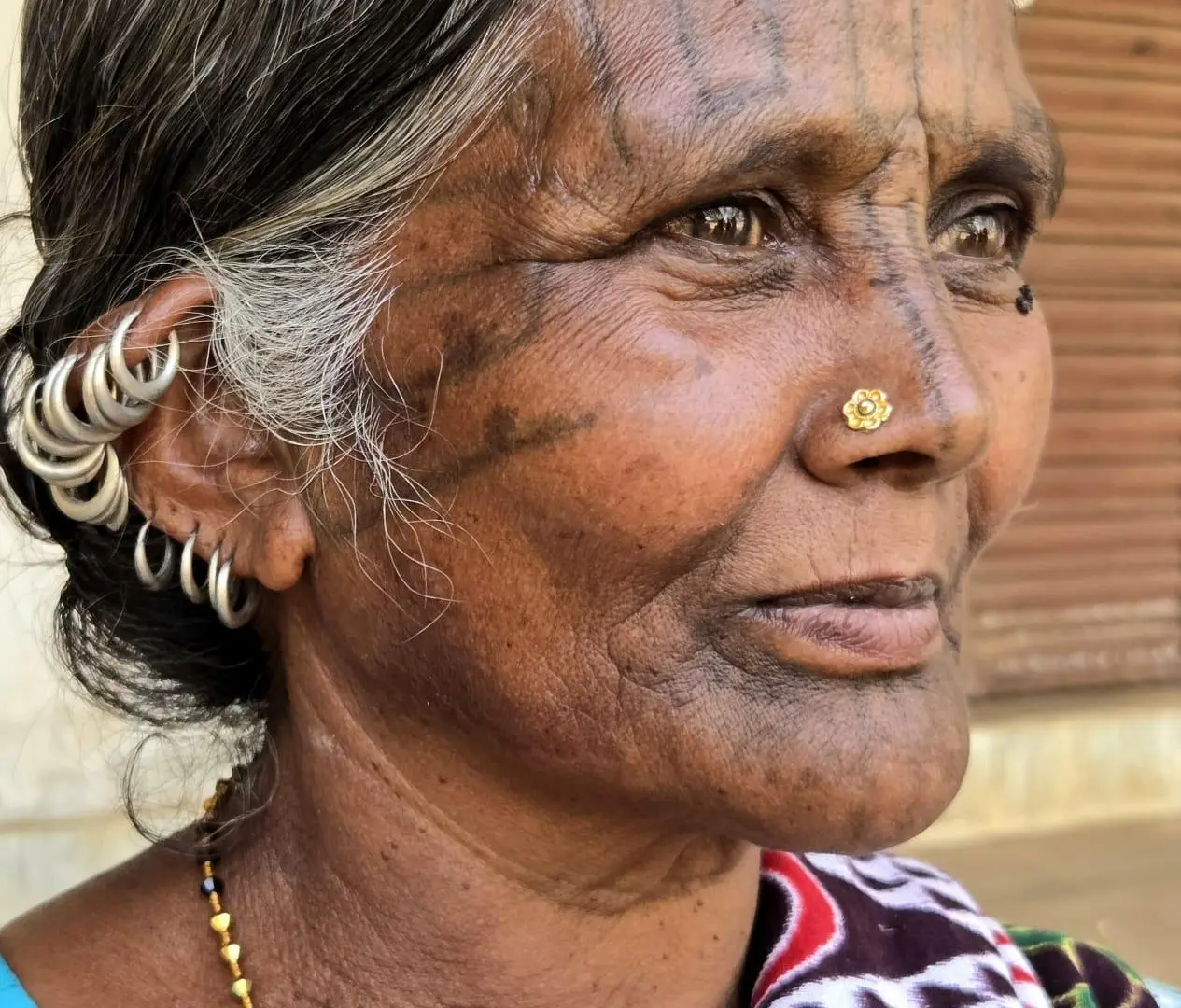
The Apatani are known for their advanced farming methods and for a unique, now abandoned custom: in the past their women tattooed their faces. It arose from the belief that Apatani women were so beautiful that men from other tribes might abduct them, so the tattoos served as a kind of protection as well as a symbol of identity and pride.
On the way to Ziro we stop to visit a Nyishi village.
The Nyishi
The Nyishi are one of the largest tribes of Arunachal Pradesh, with a strong cultural identity and striking traditional dress. The visit offers a first authentic contact with tribal daily life and an ideal introduction to the multi-tribal character of Northeast India.
Arrival in Ziro, check-in and time to relax in a wonderfully peaceful setting.
Overnight in Ziro.Day05Ziro – Apatani villages
Today is devoted to getting to know the people and way of life of the Apatani, a society that has kept its traditions intact over time.
We visit the traditional villages of Hong, Dutta and Hari, where daily life still moves at the pace of earlier times. Here Apatani houses stand side by side, creating a strong sense of community and shared life.
We have the chance to meet local people, especially the older tattooed women who still live in a strictly traditional way. These encounters are small windows into a world where values, roles and habits remain deeply rooted in the tribe's history.
We then visit the Apatani fields, a unique example of traditional, sustainable farming. The Apatani are internationally known for an agricultural system based on complete harmony between people and nature, without machines or draught animals.
Next is Ziro's local market, one of the liveliest and most authentic places in the area, offering insights into Apatani culture, customs, food, traditional dress and jewellery; every stall tells a different story of daily life.
We also visit a Ziro winery, an unexpected but fascinating experience that reveals a modern, creative side of the region.
Time for more exploring of the market and the pulse of the town.
Overnight in Ziro.Day06Ziro – Dibrugarh
(280 km / about 6 hours)
We leave Ziro for Dibrugarh, a town of special historical and economic importance known as the historic tea capital of Assam. The mountains gradually give way to open land and fertile plains.
Dibrugarh is linked not only to tea but also to modern history: during the Second World War it was a United States Army Air Forces base, playing a strategic role in the operations of the time.
It is also known for its rich oil and gas reserves, which have been key to the economic development of Assam and to the town's growth as an energy hub.
Arrival in Dibrugarh, check-in and time to rest after the drive.
Overnight in Dibrugarh.Day07Dibrugarh – Sivasagar – Mon (170 km / about 4 hours)
Today we head to one of the most remote and authentic destinations in Northeast India: Mon, in Nagaland, near the India–Myanmar border.
Mon is home to the Konyak Naga, the largest and perhaps most striking of the Naga tribes. The Konyak are known for their distinctive facial and hand tattoos and their warrior tradition; until relatively recently they were famous as headhunters. Today the descendants of these legendary warriors live in isolated villages among green hills, still keeping many elements of their traditional culture.
The road to Mon winds along narrow country roads of dirt and gravel, a real adventure deep into authentic India, far from the usual tourist trails.
On the way we make a short detour to the historic town of Sivasagar, once the capital of the Ahom kingdom of Assam, known for the impressive monuments of a powerful dynasty that ruled the region for centuries.
We visit the Sivasagar Tank (Joy Sagar), a huge artificial lake built by the Ahom kings and one of the town's landmarks, surrounded by historic buildings, temples and palaces.
We then see the Rang Ghar, an impressive 18th-century royal amphitheatre where the Ahom kings watched games and cultural events, and the Talatal Ghar, one of the largest Ahom palaces, known for its underground rooms and secret tunnels used as a military base and shelter.
Late in the afternoon we continue to Mon, the gateway to the world of the Konyak, where we spend the night and prepare for the unique encounters ahead.
Overnight in Mon.Day08Mon – Hongphoi and Longwa villages
Early in the morning we drive from Mon to the village of Hongphoi for a close, meaningful encounter with the local tribes and their rich culture, an authentic look at daily life in Nagaland, far from anything staged.
About 85% of Nagaland's population works in farming, so the land is at the centre of life. The daily life of people in Northeast India is closely tied to the needs of the soil; the harvest determines the wellbeing of each tribe, so it is no surprise that culture, outlook and even the perception of life revolve around nature's yearly cycle.
We then visit Longwa, one of the largest and most unusual villages in the Mon district, a quiet, peaceful place and one of the best spots to learn about Naga culture in depth.
In Longwa we visit the part of the village inhabited by the Konyak Naga, getting a direct picture of their daily life and social structure.
Longwa is a real geographical and cultural curiosity: the village lies in both India and neighbouring Myanmar (Burma), with half the houses on each side of the border. Yet the whole village is ruled by a single chief, the Ang.
We visit the Ang's house, a sight in itself, as the border literally cuts through it, a scene unique in the world where political geography meets daily life.
Four rivers cross the village and are shared between the two countries: the Tegi and Tapi flow to the Indian side, while the Tezak and Sumniu flow towards Myanmar, adding to the feeling of a place where borders are more theoretical than real.
Return to Mon, dinner and overnight at the hotel.Day09Mon – Jorhat
(200 km / about 4 hours)
In the morning we leave Mon for Jorhat, widely known as the "tea treasury" of India. Our route leads from the remote mountains of Nagaland to the fertile plains of Assam, where nature is gentler but just as impressive.
The name Jorhat comes from "Jor", meaning union, and "Hat", meaning market, reflecting the town's traditional role as a meeting place for people, goods and cultures.
Jorhat is also home to the oldest golf course in Asia and the third oldest in the world, giving the town an unexpected colonial character.
Yet the real magic of Jorhat lies in the vast tea gardens around it. Plantations stretching as far as the eye can see are a calm yet captivating spectacle. Walking through them, you see workers carefully picking leaves, tending the plants and clearing the rows, continuing a centuries-old tradition that is still alive today.
This experience adds a quieter, almost meditative dimension to the trip, an ideal balance after the intense tribal images of the previous days.
Arrival in Jorhat and check-in.Day10Jorhat – Kohima
(220 km / about 5 hours)
Morning departure for Kohima, the capital of Nagaland and home of the imposing Angami Naga. At an average altitude of about 1,261 metres, the town enjoys a cool climate and impressive mountain views.
The name Kohima was given by the British, who could not pronounce the original Angami name, Kewhima or Kewhira, meaning "the land where the Kewhi flower grows" in Tenyidie. The Kewhi is a wild flowering plant of the local mountains and a natural symbol of the place.
Kohima is built along a high mountain ridge, with the town winding along the crests, a layout typical of Naga settlements, where geography and defence always dictated how villages were built.
On the way we stop at the market in Dimapur, a lively trading centre where different tribes, goods and everyday scenes of modern Nagaland meet, an interesting contrast between tradition and modernity.
Arrival in Kohima, transfer and check-in, with time to rest and adjust to the mountain setting.Day11Kohima – Hornbill Festival
Today is devoted to one of the most spectacular and authentic cultural events in all of India: the Hornbill Festival, Nagaland's foremost festival. It is a unique chance to see, photograph and experience the culture of the region's tribes, gathered in one place, alive and real.
All the tribes of Nagaland meet here to present their customs, traditions, dances, music, dress and rituals, creating an impressive mosaic of cultures. The whole day is spent at Kisama Village, the official festival venue, following the festival's official schedule.
Kisama becomes a living stage where the Naga tribes revive their warrior heritage, their daily practices and their deep bond with nature and community. The performances are not shows staged for tourists but genuine expressions of cultural identity.
In the afternoon and early evening we visit the Hornbill Night Carnival (18:00 – 21:00), where colourful, brightly lit stalls offer local food, crafts, music and images of both modern and traditional Nagaland.
Return to the hotel.
________________________________________
The Hornbill Festival began in 2000, when the State Government of Nagaland launched an ambitious project to promote tourism: a week-long festival coinciding with Nagaland Statehood Day on 1 December.
It is named after the hornbill, a bird that holds a prominent place in Naga cultural and spiritual tradition and symbolises the spirit of "unity in diversity". Today it is one of the largest cultural celebrations of India's indigenous tribes, drawing thousands of visitors from around the world.
Although modern life has entered tribal daily life, their rich traditions, unique heritage and customs are remarkably well preserved and shown during these days through an explosive mix of culture, dance and traditional games.Day12Kohima – history, memory and Angami villages
The morning begins with a visit to the Kohima War Cemetery, a place of deep memory and silence dedicated to the officers and soldiers who made the ultimate sacrifice in the Second World War, in the fierce battles fought here, among the most important yet least known of the war.
Each grave has a simple but moving bronze epitaph that captures the human cost of the conflict. The memorial bears the famous words carved in stone:
"WHEN YOU GO HOME TELL THEM OF US AND SAY,
FOR YOUR TOMORROW WE GAVE OUR TODAY."
Words that sum up the meaning of sacrifice with absolute clarity and leave visitors in deep reflection.
We then leave on a day trip to Khonoma, a historic Angami warrior village known for its battles against the British and its leading role in the Naga independence struggle. Khonoma was a symbol of resistance and self-determination, and its warrior history is part of Nagaland's collective memory.
In recent years Khonoma has become famous for a completely different reason: it is a model of community-led nature conservation, with innovative environmental and eco-tourism programmes showing how a traditional society can evolve without losing its identity.
Next we visit Kigwema, a mountain Angami village that was the scene of a fierce attack by Japanese troops on 4 April 1944 at exactly 15:30, a violent moment still remembered here.
At the entrance to the village a simple stone memorial marks the exact spot where the settlement begins, a silent witness to the brutality of war. Kigwema also offers an excellent chance to see the traditional Angami way of life, still alive in its architecture, habits and daily routine.
The day ends with a warm experience: a meeting with an Angami family, an authentic glimpse of the private, human side of this culture. In the afternoon we return to Kohima and visit the local market.
Overnight in Kohima.Day13Kohima – Dimapur – Delhi
(70 km / about 3 hours by road + flight)
After breakfast, check-out in Kohima and drive to Dimapur, Nagaland's main air and transport hub.
Arrival at Dimapur airport and flight to Delhi.
On arrival in the capital, transfer to an airport hotel to rest after the intense and rich journey through Northeast India.
Dinner at the hotel.Day14Departure from Delhi
Packed breakfast and early transfer to the airport. Flight to Athens. Home again with wonderful memories and experiences.
Good to know
What's included
Included
- International flights with Turkish Airlines Athens – Delhi – Athens.
- Indian tourist visa.
- Domestic flights within India.
- 5* hotels in Delhi and the best available accommodation throughout Northeast India
- Meals in Delhi: buffet breakfast and dinner at the hotel.
- Meals in Northeast India: breakfast and dinner (buffet or set menu) as per the programme.
- Transport in Delhi by air-conditioned coach.
- Transport in Northeast India by air-conditioned Toyota Innova Crysta
- English-speaking guides throughout the programme
- Greek-speaking tour leader with many years of experience
- Protected Area Permits (PAP) for Arunachal Pradesh and Nagaland.
- Separate vehicle for the tour of Majuli island.
- Village visit fees.
- Hi-tea with a local family in Kohima.
- Entrance fees to monuments and museums
- All applicable local taxes.
- Travel insurance
Not included
- Additional meals
- Alcoholic drinks with meals
- Personal expenses such as tips, laundry, phone calls, drinks or other personal costs
- Anything not explicitly listed as included.
Moments
Gallery